
Uterine Cancer Treatment in Delhi NCR
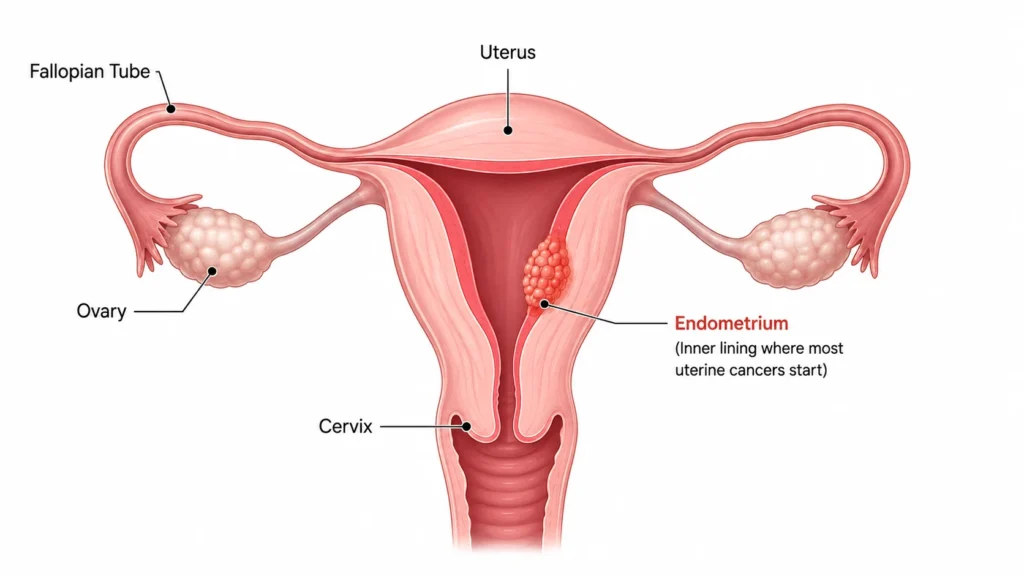
Uterine cancer is cancer that develops in the uterus (womb), the most common type is endometrial cancer, which starts in the inner lining of the womb, and it is the most frequently diagnosed gynaecological cancer in urban India.
The uterus is the pear-shaped organ in a woman’s pelvis where a baby grows during pregnancy. When cancer develops here, it most commonly starts in the endometrium, the tissue that lines the inside of the womb. The good news is that uterine cancer is often caught early because it causes abnormal bleeding, which sends most women to their doctor sooner than with other cancers.
Two main types of uterine cancer:
- Endometrial carcinoma, starts in the inner lining (endometrium); accounts for more than 90% of all uterine cancers; strongly linked to oestrogen exposure and obesity
- Uterine sarcoma, starts in the muscle or connective tissue of the womb wall; rarer but more aggressive; treated differently from endometrial carcinoma
What Causes Uterine Cancer?
Uterine cancer is most commonly caused by excess oestrogen, anything that increases oestrogen exposure over a long period raises the risk, including obesity, hormone therapy, and never having been pregnant.
Key uterine cancer risk factors:
- Obesity – the single biggest uterine cancer risk factor in India; fat tissue produces oestrogen, which stimulates the womb lining; obese women have 2 to 4 times the risk of developing endometrial cancer
- Never having been pregnant – pregnancy temporarily lowers oestrogen levels; women who have never carried a baby have higher lifetime oestrogen exposure
- Late menopause – more years of menstruation means more oestrogen exposure
- Oestrogen-only hormone replacement therapy (HRT) – oestrogen given without progesterone significantly raises risk
- Polycystic ovary syndrome (PCOS) – causes irregular periods and higher oestrogen levels
- Tamoxifen – a breast cancer drug that acts like oestrogen on the womb lining; women on tamoxifen need regular gynaecological monitoring
- Diabetes and high blood pressure – associated with higher uterine cancer risk, possibly through their link with obesity
- Family history and Lynch syndrome – women with Lynch syndrome (hereditary colorectal cancer syndrome) have a significantly higher lifetime risk of uterine cancer
- Age – most cases occur in women above 50, after menopause
Symptoms of Uterine Cancer
The most important and common symptom of uterine cancer is abnormal vaginal bleeding, any bleeding after menopause, or unusual bleeding between periods, must be evaluated by a specialist immediately.
This is one cancer where symptoms appear early in most cases which is why outcomes are generally better than many other cancers. Never ignore:
- Postmenopausal bleeding – any vaginal bleeding after menopause is abnormal and must be investigated without delay; it is the most important warning sign of endometrial cancer
- Abnormal bleeding between periods in pre-menopausal women – particularly heavy, prolonged, or irregular periods
- Unusual vaginal discharge – watery, blood-tinged, or foul-smelling discharge
- Pelvic pain or pressure – persistent discomfort in the lower abdomen or pelvis
- Pain during sex
- Difficulty urinating or a feeling of pressure on the bladder
- Unexplained weight loss (in more advanced cases)
- A feeling of fullness or a palpable mass in the lower abdomen
A simple rule: Any bleeding after menopause is not normal. Please see a uterine cancer specialist in Delhi NCR the same week it happens.
Reach Out for Expert Care
How Is Uterine Cancer Diagnosed?
Uterine cancer is diagnosed through endometrial biopsy, a small tissue sample taken from the womb lining, supported by transvaginal ultrasound and MRI scan to assess the extent of disease.
Dr. Surender Kumar Dabas uses a step-by-step uterine cancer diagnosis process:
- Pelvic examination – checks the uterus, ovaries, and surrounding tissue for any abnormality
- Transvaginal ultrasound (TVUS) – the first-line imaging test; measures the thickness of the womb lining; a thickened endometrium in a post-menopausal woman is a strong indicator requiring biopsy
- Endometrial biopsy – a small sample of the womb lining is taken in the clinic (usually without anaesthesia); confirms whether uterine cancer is present and what type it is
- Hysteroscopy – a thin camera is passed into the womb to look directly at the lining and take a more targeted biopsy if needed
- MRI pelvis – the most important scan for surgical planning; shows how deeply the cancer has invaded the womb wall and whether it has spread to the cervix or nearby tissue
- CT scan of the chest, abdomen, and pelvis – checks for spread to lymph nodes or distant organs
- PET-CT scan – used for higher-grade tumours to detect any distant spread
- CA-125 blood test – elevated in some cases; used as a baseline marker
- Lynch syndrome genetic testing – offered to all women diagnosed under 60 or with a family history of colorectal or endometrial cancer
Stages of Uterine Cancer
Uterine cancer is staged from Stage I to Stage IV, most women in India are diagnosed at Stage I because abnormal bleeding brings them to the doctor early, giving excellent chances of complete cure.
| Stage | What It Means |
| Stage I | Cancer is confined to the uterus |
| Stage IA | Cancer has not or barely invaded the womb muscle |
| Stage IB | Cancer has invaded more than half of the womb muscle |
| Stage II | Cancer has spread to the cervix (neck of the womb) |
| Stage III | Cancer has spread outside the womb to nearby tissues, ovaries, or lymph nodes |
| Stage IV | Cancer has spread to the bladder, bowel, or distant organs |
Stage I uterine cancer, the most common stage at diagnosis, has an excellent prognosis with surgery alone. Even Stage II and selected Stage III cases are highly treatable with surgery and radiation.
Uterine Cancer Treatment Options in Delhi NCR
Uterine cancer is treated primarily with surgery, surgical removal of the uterus (hysterectomy) is the cornerstone of treatment for most women, often followed by radiation or chemotherapy depending on the stage and risk.
Dr. Surender Kumar Dabas, one of the best uterus cancer doctor in Delhi NCR and a specialist in gynaecologic oncology, offers every modern uterine cancer treatment option, tailored to your stage, tumour type, and life priorities.
- Robotic Hysterectomy for Uterine Cancer
- The preferred surgical approach for uterine cancer at Dr. Dabas’s practice.
- The uterus, cervix, both fallopian tubes, and both ovaries are removed (total hysterectomy with bilateral salpingo-oophorectomy)
- Robotic hysterectomy uses the Da Vinci Xi system, 3D vision and robotic arm precision inside the pelvis
- Key patient benefits:
- Much smaller cuts – 4 to 5 tiny incisions instead of one large cut
- Significantly less blood loss
- Less pain after surgery
- Home typically within 2 to 3 days
- Back to normal activities within 3 to 4 weeks (vs. 6 to 8 weeks for open surgery)
- Dr. Surender Kumar Dabas is one of the best robotic cancer surgeons in Delhi NCR and offers robotic hysterectomy for uterine cancer for most eligible patients
- Laparoscopic (Keyhole) Hysterectomy
- Minimally invasive surgery using a laparoscope and small incisions
- Offers similar patient benefits to robotic surgery, faster recovery, less pain, shorter hospital stay
- Used when robotic surgery is not required for the complexity of the case
- Open (Abdominal) Hysterectomy
- A single larger incision in the lower abdomen
- Used for very advanced or complex cases where a larger field of view is needed
- Also used when uterine cancer has spread to surrounding structures requiring more extensive surgery
- Lymph Node Assessment – Sentinel Node Biopsy and Pelvic Lymphadenectomy
- The lymph nodes around the uterus are the first place uterine cancer spreads
- Sentinel lymph node biopsy, a minimally invasive technique using a dye to identify and remove only the first draining lymph nodes; reduces side effects compared to full lymph node removal
- Pelvic lymphadenectomy, full removal of pelvic lymph nodes for higher-risk cases
- Lymph node assessment is an important part of accurate uterine cancer staging and guides decisions about adjuvant treatment
- Radiation Therapy for Uterine Cancer
- Given after surgery to reduce the risk of cancer coming back locally
- Vaginal brachytherapy, internal radiation delivered directly to the top of the vagina; the most commonly used form after hysterectomy for intermediate-risk endometrial cancer; done as an outpatient; minimal side effects
- External beam radiation therapy (EBRT), used for higher-risk or more advanced disease to treat the pelvis
- Radiation alone is used as primary treatment for women who cannot have surgery
- Chemotherapy for Uterine Cancer
- Used for higher-grade, advanced, or recurrent uterine cancer
- Standard regimen: carboplatin and paclitaxel, given for 6 cycles
- Used alongside radiation (chemoradiation) for Stage III disease
- Also used as palliative treatment for Stage IV endometrial cancer
- Targeted Therapy and Immunotherapy
- Pembrolizumab – a checkpoint inhibitor approved for MSI-high or mismatch repair deficient (dMMR) uterine cancer; highly effective in this subgroup
- Lenvatinib with pembrolizumab – approved for advanced endometrial cancer that has progressed on chemotherapy; a major advance in treatment
- Hormone therapy – progestins and aromatase inhibitors used for low-grade, hormone receptor-positive endometrial cancer in women who want to preserve fertility or are not fit for surgery
Why Choose Dr. Surender Kumar Dabas for Uterine Cancer Treatment in Delhi NCR?
Dr. Surender Kumar Dabas is one of the best cancer doctors in Delhi NCR, with 22+ years of experience, 5,000+ robotic surgeries, and specialist expertise in robotic hysterectomy, sentinel node biopsy, and complete gynaecologic oncology care.
- 22+ years of experience in surgical oncology including uterine cancer, ovarian cancer, and complex gynaecological cancers
- One of the Best robotic cancer surgeon in Delhi NCR and India, performs robotic hysterectomy for uterine cancer using the Da Vinci Xi system; most patients go home within 2 to 3 days
- 5,000+ robotic surgeries and 30,000+ complex cancer surgeries performed
- One of the Best cancer doctor in Dwarka, consults at Manipal Hospital, Sector 6, Dwarka, one of the best-equipped cancer surgery hospitals in Delhi NCR
- Sentinel lymph node biopsy expertise, minimises surgical side effects while ensuring accurate staging for every patient
- Lynch syndrome pathway, all eligible patients offered genetic testing and family counselling as part of the treatment pathway
- Multidisciplinary care, works with medical oncologists, radiation oncologists, and genetic counsellors to build a complete, personalised uterine cancer treatment plan
- Speaks to you simply, explains diagnosis, staging, surgery, and all treatment options in plain language so you and your family feel fully informed and confident
- You are never rushed, every patient gets the time they need to understand their situation and ask questions
- Patients from Delhi, Noida, Gurgaon, Faridabad, and abroad seek uterine cancer treatment by Dr. Surender Kumar Dabas
Uterine Cancer Treatment Cost in Delhi NCR
The cost of uterine cancer treatment in Delhi NCR depends on:
- Stage and grade of cancer
- Type of surgery: robotic hysterectomy, laparoscopic, or open surgery
- Whether lymph node dissection or sentinel node biopsy is performed
- Radiation therapy type: vaginal brachytherapy or external beam radiation
- Chemotherapy or immunotherapy requirements
- Hospital stay and post-operative care
Robotic hysterectomy typically means a shorter hospital stay (2 to 3 days vs. 5 to 7 days for open surgery) and faster return to normal life, which reduces the overall cost of recovery. For a personalised uterine cancer treatment cost estimate in Delhi NCR, book a consultation with Dr. Surender Kumar Dabas.
If you have noticed any bleeding after menopause, or unusual vaginal bleeding at any age that concerns you, please do not wait.

Dr. Surender Dabas' Medical Content Team
Dr. Surender Dabas' Medical Content Team is committed to providing accurate, reliable, and easy-to-understand information on cancer care. Working closely with oncology experts, the team ensures that every article is medically reviewed, up-to-date, and designed to help patients and their families better understand cancer, treatment options, and recovery.

 WhatsApp